Short answer
There is no single price for lift replacement in Singapore. BCA sinking-fund planning guidance is that building owners should set aside at least $120,000 for each lift. That is a floor rather than an estimate: it is calibrated to typical mid-rise installations, and a high-rise tower will exceed it substantially, because landing entrances, door equipment, indicators and fixtures repeat at every floor. The real cost is driven by landings served, travel height, rated load and speed, control configuration, whether a fireman’s lift is in scope, and the phasing needed to keep the building served.
Key facts
- BCA sinking-fund planning guidance is that building owners should set aside at least $120,000 for each lift. Treat it as a floor for planning, and confirm the current published figure when you budget.
- The number of landings is usually the largest single cost driver — landing entrances, door equipment, indicators and fixtures are supplied and installed once per floor.
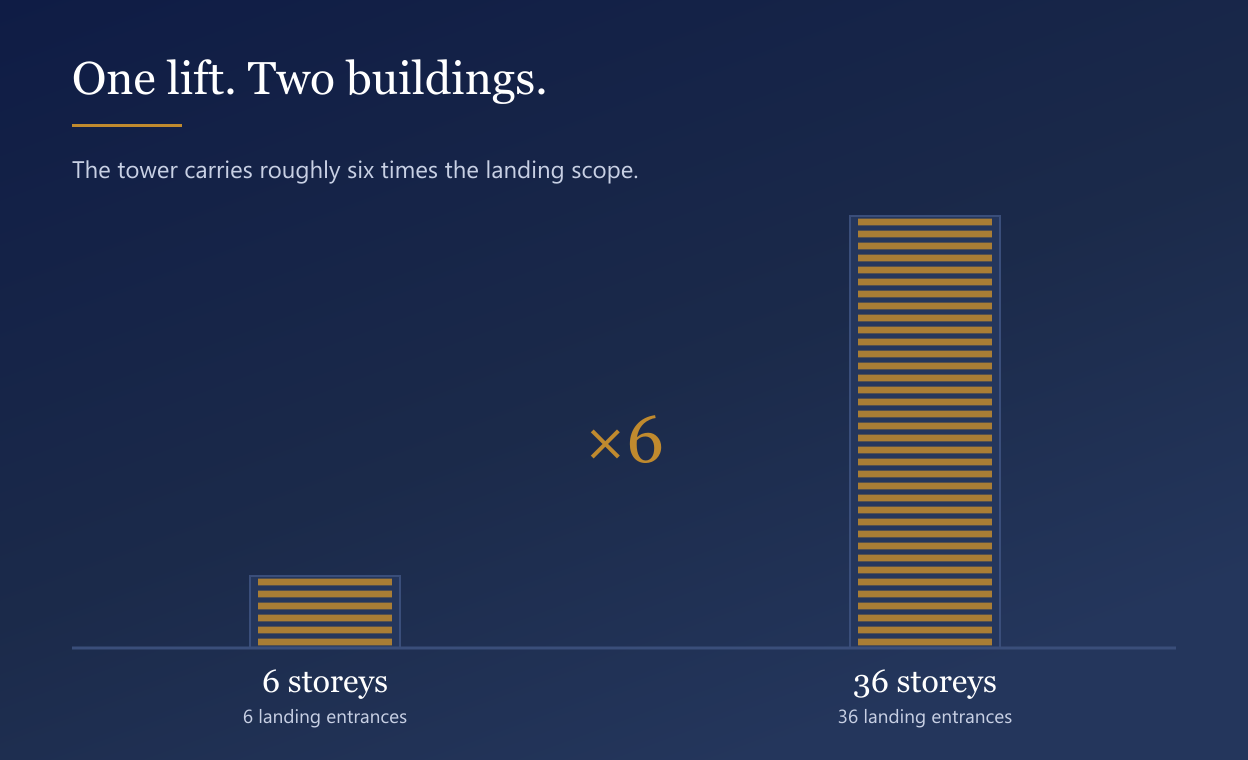
- A 36-storey tower carries roughly six times the landing scope of a six-storey block for the same single lift.
- A fireman’s lift is not a like-for-like item with a passenger lift in either scope or price.
- A budget built only on the lift contract sum is incomplete — authority fees, builder’s work, electrical supply, consultancy and contingency sit outside it.
Why is there no single price for lift replacement?
Because the cost of a lift is driven far more by the building it serves than by the lift itself. Two buildings of the same age, in the same district, with the same number of lifts, can carry replacement costs that differ by a factor of several.
That is uncomfortable for a council that needs a number to put in front of owners. But an invented number is worse than no number, because it becomes the basis for a sinking fund provision that turns out to be short — and the shortfall is then met by a special levy at the least convenient possible moment.
Is the BCA $120,000 per lift figure reliable?
It is reliable as a planning floor and unreliable as an estimate for a specific building. For sinking fund planning purposes, Building and Construction Authority guidance is that building owners should set aside at least $120,000 for each lift. It is a useful reference point and councils are right to know it. It is also widely misused.
The figure is planning guidance calibrated to typical installations — and typical, in this context, means mid-rise. Applied to a high-rise tower as though it were an estimate, it will leave the provision materially short, because the elements that scale with height are precisely the elements that dominate the contract value.
Budgeting from that figure alone is the single most common route by which a Singapore MCST arrives at an under-funded project. Treat it as the floor beneath which no provision should ever be set, confirm the current published figure at the time you budget, and do not treat it as an estimate for your building.
What makes one lift cost more than another?
The number of landings and the travel height usually account for most of the difference between one building and another. Everything else adjusts around them.
- Number of landings served — usually the largest single driver, because landing entrances, door equipment, indicators and fixtures are supplied and installed once per floor
- Travel height — ropes, cables, governor and machine must all be sized for the rise, and installation labour and access scale with it
- Rated load and speed — heavier and faster means larger machines, heavier ropes and higher-specification controls
- Control configuration — whether lifts run individually or as a group, and what building systems the replacement must interface with
- Whether a fireman’s lift is in scope — it carries obligations a passenger lift does not, and is never a like-for-like item on either scope or price
- Scope — full replacement or a defined partial modernisation, which moves the number more than any negotiation will
- Phasing and access — where lifts must be replaced one at a time to keep the building served, the programme lengthens and costs stack accordingly
- Builder’s work and electrical supply — lobby making-good, machine room alterations and supply upgrades are commonly outside the lift contractor’s scope
Which of these dominate, and by how much, is specific to your building. That is why an estimate worth budgeting against has to be built from the actual installation rather than from an average.
Is partial modernisation cheaper than full replacement?
Partial modernisation always shows a lower contract sum. That is not the same as being cheaper, because the comparison that matters is cost against expected remaining service life.
| Partial modernisation | Full replacement | |
|---|---|---|
| Contract sum | Lower | Higher |
| Life gained | Limited by the oldest retained component | A full service life, typically 20–30 years |
| Obsolescence exposure | Remains on the retained equipment | Resets to zero |
| Disruption | Shorter per lift | Longer per lift |
| Warranty position | Covers new components only | Covers the whole installation |
| Downside risk | Retained equipment fails early; the building pays twice | Larger capital outlay committed at once |
Partial modernisation at a considerably lower price that delivers eight further years may be better value than full replacement — or considerably worse than full replacement delivering twenty-five, depending on the numbers. Where retained equipment fails within a few years of the works, the building pays twice and lives through the disruption twice. This is a judgement worth forming independently of any single proposal, and it is exactly what a life-cycle assessment and options study is for.
What costs are not included in the lift contract?
A budget built only on the lift contract sum is incomplete. Seven categories commonly sit outside it and must be provided for separately.
- Authority submission and certification fees
- The professional appointments a lift project requires, where these are charged separately
- Structural, builder’s, electrical supply or architectural works to lobbies, shafts and machine rooms, and any associated professional appointments
- Independent third-party or laboratory testing, if commissioned
- Legal review of the contract documents
- Consultancy fees for specification, tender, project management and contract administration
- A contingency for variations — smaller where the specification is precise, larger where it is not
How much should our sinking fund hold?
Enough for the whole project, not the lift contract sum alone. Lift works are among the largest capital items an MCST will ever fund, and contributions must be built up over years. Three principles keep the provision sound:
- Start from the installation, not from a rule of thumb. An indicative estimate derived from your actual lifts, landings and constraints is a different quality of number from a per-lift average.
- Set the timing from condition, not from age. Two lifts installed the same year can be in very different states at year seventeen. Establishing the position early is what converts an open-ended liability into a planned programme.
- Budget the whole project. Contract sum, plus the excluded costs above, plus contingency. Under-providing for the second and third of these is what turns a funded project into a special levy.
How do we get a real number for our building?
Two steps, in order. First establish the position with an independent assessment; then test it in the market against a written specification.
Step one — establish the position. An independent assessment of the installation determines its actual condition, which components are driving the reliability problem, what the obsolescence exposure genuinely is, and which options are realistically open — producing an indicative budget estimate suitable for sinking fund planning and for the resolution put to the general meeting.
Step two — test it in the market properly. A brand-neutral specification put out to a competitive tender and evaluated on a common footing produces a real, contractually binding price. Quotations gathered without a specification are not prices for the same thing, and averaging them produces a number that describes nothing.